
How to Build a Group Coaching Program: Start With What Already Found You
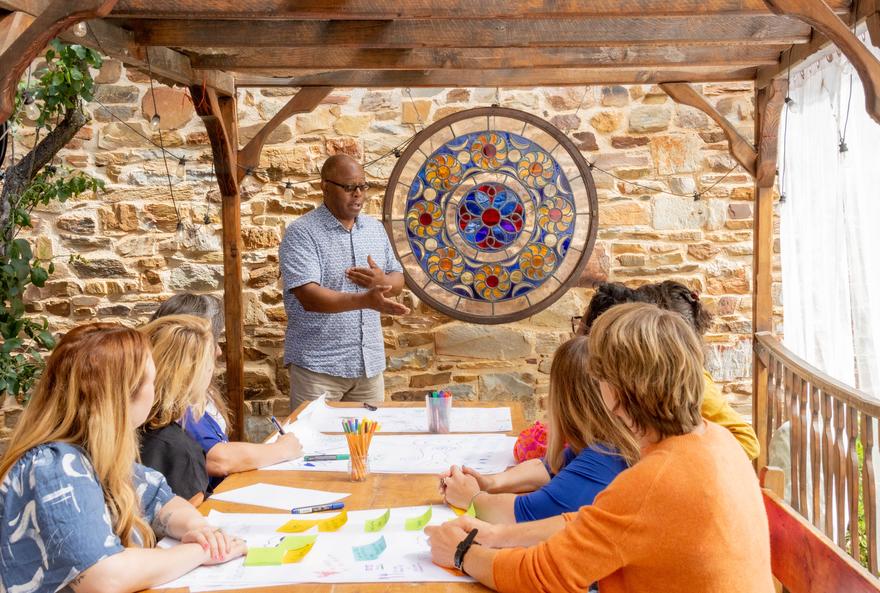
Before I started gathering people into groups, I watched my clients carry things alone.
I was known as the forgiveness coach back then. People would come into my office and share the most tender, unspoken parts of themselves. Stories they had never told anyone. Not their partners. Not their closest friends. Just me, a coach they had known for a few hours.
I kept sitting with the question: why are you telling me this when your best friend doesn't know?
Their best friend would come in the following week, and tell me the things the first friend didn't know.
I got genuinely sad about it. These people loved each other. They were in each other's lives. And they were each carrying something alone that the person sitting across from them at dinner every week would have understood completely.
That sadness was telling me something I hadn't yet put into words: the healing these people needed wasn't just between them and me. It was between them and each other.
So I created my first group coaching program. I called it The Heroine's Quest. It was only for women, and it was built around one simple invitation: come and tell your whole story, not just to me, but to the people in your life who are ready to hear it. It was about building safety and community in your own surroundings. Creating brave spaces together.
What happened in that room changed me as a coach. I was astounded by the courage people found when they weren't alone. One woman's story could unlock something in another that no amount of individual coaching had reached. You could feel people's bodies settling as they became viscerally aware, "I thought it was just me. Now I see I'm human."
That program was the seed of everything Awaken continues to become. It didn't start with a business plan, but with seeing the patterns in my clients' stories and building something that was truly needed. I built it from listening to my own sadness.
What Is a Group Coaching Program?
A group coaching program is a brave, loving space where a small group of people gather around a shared longing and grow together over several weeks. The coach holds the space with deep presence, and each person is witnessed by the whole circle as they discover their own wisdom and the courage that grows in community.
Something Is Already Calling You
You're already coaching. You're in your sessions, you're present with your clients, and somewhere underneath the work, something is stirring.
Maybe it's sadness, like mine. You keep witnessing the same isolation, the same gap, the same people who need each other and don't know it yet.
Maybe it's frustration. You see the same patterns repeating across your clients, the same struggle showing up in different lives, and something in you knows that if these people were in a room together, something would shift that no amount of one-to-one work can reach.
Maybe it's joy and a kind of restlessness, a longing to create something, to gather people around something you genuinely care about. A community that doesn't exist yet but should.
Or maybe it's quieter than any of those. A knowing. A sense that there is a group of people out there who need exactly what you carry, and that you are the right person to bring them together.
If you're reading this, that seed is already in you. You're not imagining it. And you don't need to have it all figured out before you act on it.
Emotions are messengers. In the coaching work we do at Awaken, we teach coaches to listen to what their inner world is pointing toward. The same is true for you, right now, about your practice. Whatever the emotion, it is worth paying attention to.
The Idea That Already Found You
Some people think a group coaching program begins with a market research exercise. A spreadsheet. A niche analysis.
In my experience, it almost never starts there.
It starts with something you've noticed. A gap nobody is filling. A group of people nobody is gathering. A conversation that keeps almost happening but never quite does.
The idea doesn't arrive fully formed. It arrives as an observation, a feeling, a question you can't quite let go of. And if you've been in practice for any amount of time, you've probably already had it. You've probably already been sitting on it.
What would it look like to finally do something with it?
For a fuller picture of what coaching certification can look like as a whole, our complete guide to coach certification training covers every pathway and program in depth.
Why Develop Your Group Coaching Program in Community?
The most natural place to learn to lead a group is inside one. When you design your program within a small cohort of coaches, you experience group coaching from the participant's seat every week, and you feel what your own participants will feel: the synergy, the collective wisdom and the courage that grows in company.
Your program also grows richer as you listen to other coaches share their ideas, their experience and the programs taking shape beside yours. A question one coach asks about their own participants can open a new direction for you, and the encouragement of the whole group gives you the confidence to bring your program into the world.
You can explore who the training serves in my guide to group coaching certification.
The questions below are the ones coaches bring to me most often as they move from the seed of an idea to a living program. Every answer builds on the coaching skills you already carry into your one-to-one sessions.
Why Would Someone Choose Group Coaching Over One-to-One?
Participants love the synergy of people moving toward similar goals. The group's collective wisdom brings ideas and energy beyond what any one member would find alone, and friendships often last well beyond the program. Groups also make coaching more affordable for participants and let you serve more people within the hours you have. For many of us, the deepest reason is the transformation that happens only in groups, and the love, trust and bravery we feel when a group carries each person on their journey.
In the cohort: you name your own big why, with a clear number for the income, freedom or impact you hope your program brings, among coaches who celebrate it with you.
Who Is Your Group Coaching Program For?
Begin with a simple question: who do you want to spend most of your time and energy with this year? Picture your favorite client so clearly that you could draw them in their own surroundings, then reach out to a few people like them and ask what they long for. At Awaken, we choose participants for their love and bravery, and naming your own who with the same clarity lets the right people recognize your invitation.
In the cohort: you shape your ideal participant with fellow coaches, who help you see your people more vividly than you could alone.
What Transformation Will Your Program Offer?
Your theme lives where your participants' challenges meet their deepest desires. Ask what keeps your people awake at night, and what they long for in their heart of hearts. The transformation your program offers is the bridge between the two, shaped by your own gifts and experience.
In the cohort: you speak your theme aloud and notice which words make the room lean in.
How Do You Design a Group Coaching Program?
Ask what your participants need to experience to reach the outcome they long for, and let the answer shape every choice. Most programs combine live sessions with an online space for the group, reflection between sessions and simple support materials, and starting simple works beautifully. Six to twelve participants give everyone time to take part fully, and I share why our own cohorts stay small in why small cohorts create better coaches. Let the length match the change you hope for: twelve weeks suits many programs that build new habits.
In the cohort: you watch several programs take shape beside yours, each one offering ideas for your own.
What Does Coaching a Group Ask of You?
Every skill you use with one-to-one clients carries into the room: connection, listening, powerful questions, observations, accountability and celebration. Groups also invite you to grow new skills, such as creating collective agreements, holding your own emotional state even more deeply and guiding a conversation so every voice is heard. Teaching travels as pre-work, so session time belongs to connection, insight and commitment.
In the cohort: you experience these skills every week from the participant's chair, which is how Bob Armour knew how to run his program by week three. I explore the shift more fully in From 1:1 to Group Coaching: What Carries Over and What Expands
How Do You Invite People Into Your Program?
Marketing begins in the same state of presence you bring to a coaching conversation, as an opportunity for people to say yes to themselves. Start with your warm circle, the people who already know and trust you. Most enrollments happen in a real conversation, where your coaching skills listen for each person's hopes and hesitations. Price your program for the outcome and the value it adds to people's lives.
In the cohort: you write your own invitation and receive generous feedback before it reaches a single future participant.
How Do You Know Your Program Works Before You Launch?
Run your program once, among people who want you to flourish, and refine it from what you notice. A first live run turns a plan into lived experience and gives you real confidence for the launch that follows.
In the cohort: you host almost a full hour of your own program live, with fellow coaches as participants, then review and refine it together in the final week.
Meet Bob Armour and the Healthy High Street
Bob Armour, PCC, was already coaching one-to-one when he noticed something that bothered him.
Small businesses on the same high street, people working side by side, sometimes for years, weren't talking to each other. They weren't sharing what they knew. They weren't building the kind of community that could make all of them stronger. Bob had spent nearly his entire corporate career watching what happens when communication breaks down. He knew what was missing. He just didn't know how to turn what he was seeing into something he could offer.
He enrolled in Awaken's Group Coaching Certification. He finished in December. He ran his proof of concept in February. The Healthy High Street program launched in March.
That program, built for a niche most coaches wouldn't think to enter, for clients most coaches assume can't afford coaching, came directly out of the course. Not from a business plan. From a noticing he'd been carrying for years.
Bob is now offering Awaken's Group Coaching Certification program as faculty. Watch him talk about his Healthy High Street program in his own words.
What Happens Inside the Course
One of the things Bob says about his experience that I find most telling is this: by week three, he already knew exactly how to run his program. Not because someone handed him a formula, but because he was experiencing the method in real time while building his own version of it.
That is precisely what the course is designed to do.
At Awaken, we limit each cohort to eight participants. That means every person in the course gets to host almost a full hour of their own group coaching program live, inside the group, with their peers as participants. You write the invitation email. You structure the session. You run it. And you receive real, generous feedback from people who are building alongside you.
By the time you finish, you don't just have a concept. You have something you've already run once.
You leave with the confidence that the program works, because you've watched it work. And because the course teaches you the architecture rather than prescribing the content, you can return to it any time you want to build something new. The course gives you lifetime access. A second group program, a corporate offering, a completely different audience, the framework travels with you.
Bob is proof of that. The format he built for the Healthy High Street is the same format he now uses in corporate group coaching engagements. Every week.
For a deeper look at the five elements that make group coaching transformational, read The Transformational Group Coaching Framework.
Your Program Doesn't Need to Be Finished
If you're wondering whether your idea is developed enough, specific enough, or marketable enough to bring into the course, that wondering is normal, and it isn't a reason to wait.
Bob's idea wasn't finished when he arrived. Mine wasn't either, when I first started gathering people together.
The course is not a place you come to once you have everything figured out. It's the place where the figuring out happens, in community, with real support, and with the lived experience of group coaching shaping your thinking as you go.
What you need to bring is the seed. The noticing. The emotion that's been pointing you somewhere.
The course does the rest.
To understand more about why group coaching aligns energy, income and impact in a way that one-to-one work alone rarely does, read Belong to Yourself: How Group Coaching Certification Aligns Your Energy, Income, and Impact.
Do Group Coaching Hours Count Toward Your ICF Credential?
Group coaching counts toward ICF client coaching experience hours when the group has 15 participants or fewer, and each person counts as a client. The hours equal the length of the session, so one hour with eight people counts as one hour (ICF experience requirements). Our Group Coaching Course also includes 40 ICF Core Competency hours toward a Level 2 (PCC) application and credential renewal, and I explore renewal options in ICF renewal hours. Your client coaching hours and the ICF exam remain your own path to walk.
Questions to Carry With You
Before you close this page, take a moment to sit with these questions.
- Which emotion has been drawing you toward a group, and what is it asking of you?
- Whose faces come to mind when you imagine your first circle?
- What would you love those people to carry home from the final session?
- What small step would let you begin this week?
Ready to Build Your Group Coaching Program?
The Group Coaching Certification runs twice a year, each March and October.
Each cohort gathers up to eight coaches for 11 weeks and includes 40 ICF Core Competency hours.
If something in this post stirred recognition, if there is an emotion that's been pointing you somewhere, an idea that hasn't quite left you alone, we'd love for you to explore whether this is your next step.
Join our live Q&A call and bring your idea with you.
Learn more about the ICF-accredited Group Coaching course here
P.S. If you're still exploring coach certification more broadly, our complete guide to coach certification training is the best place to start.
About the Author
Christi Byerly, MCC, is the founder and CEO of Awaken Coach Institute. Her coaching process motivates you to build a community of empathy and grace around you, and to live your mission as part of something bigger than you are. With over 15 years of coaching experience, Christi has trained hundreds of new coaches and maintains a thriving practice focused on depth, presence, and authentic transformation.
FAQs
How long does it take to create a group coaching program? Many coaches move from an idea to their first group within a few months. In our 11-week Group Coaching Course, each coach designs their own program and hosts almost a full hour of it live with peers. Bob Armour, PCC finished the course in December and launched his program the following March.
How do I find my niche for a group coaching program? Start with what you've already been noticing. What themes keep appearing across your one-to-one clients? What gap do you keep seeing that nobody is filling? What group of people do you find yourself most drawn to? In Awaken's Group Coaching Certification, one of the first and most important pieces of work is identifying your "who" and your "what", and the course is specifically designed to help you get clear on both.
How much can I charge for a group coaching program? Group coaching pricing varies widely depending on the niche, the length of the program, and the transformation it creates. The key is pricing for the transformation you're creating, not just your time. Rather than pricing by the hour, begin with your income goals and the number of people you hope to serve, then let the price reflect the value your program brings to participants' lives. A price that feels congruent to you welcomes participants who are ready to commit to their own growth.
What's the difference between group coaching and facilitation? Facilitation tends to work with larger groups and focuses on guiding a process or agenda. Group coaching is more intimate, typically 15 people or fewer, and centers on using coaching skills to help participants access their own wisdom, set real goals, and support each other toward meaningful change. The coach is not the expert delivering answers; they are holding the space for the group to generate them.
Can I create my group coaching program while I train? Our Group Coaching Course is built for exactly that purpose: you design your own program week by week, then host almost a full hour of it live, with fellow coaches as your participants.

0 comments
Leave a comment
Please log in or register to post a comment