
Trusting the Path: What Transformational Coaches Need to Know
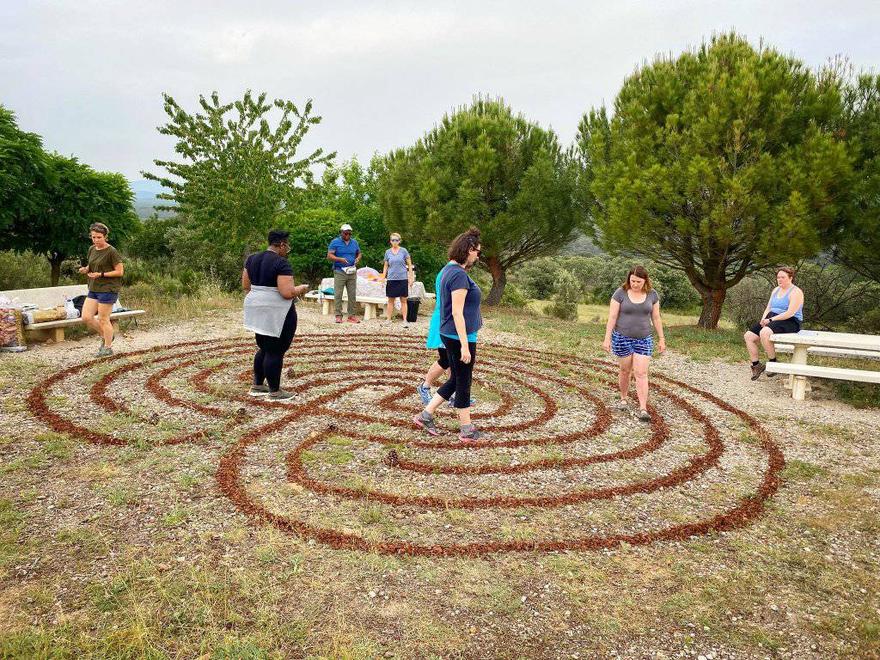
The red earth of Kenya, called murram, has a way of grounding me before my head even realizes I've moved. I remember standing at the entrance of the 7-circuit Chartres labyrinth at the Mwangaza Jesuit Spirituality Centre, under an acacia tree, the sun dappled on my shoulders, and the silence of the retreat grounds humming around me.
In a labyrinth, unlike a maze, there are no dead ends. There is no way to get lost. Yet, as I begin to walk, my ego brain is still in that achievement orientation of getting to the center efficiently.
I take a few purposeful steps toward the center, feeling confident, only to have the path veer sharply to the left, and after numerous twists and turns, sending me back toward the outer edge, farther from the center than ever.
I feel a familiar prickle of confusion. Am I doing this right? But the labyrinth is a patient teacher. It reminds me that, while the meanders feel like regressions, they are all part of the pattern. The birds whirling overhead see the path from a much more lucid perspective. There are no wrong turns; just a beautiful weaving together of shapes.
As coaches, we often talk about "trusting the process," but my time at Mwangaza taught me something deeper: We must trust the Path itself, not just our ability to navigate it.
This shift, from relying on techniques to trusting the ground beneath your feet, is at the heart of what makes coaching truly transformational. When coaching starts with Love rather than skills, the Path becomes your teacher, not your obstacle.
The Architecture of the Meander
In transformational coaching, I often witness my clients hitting that "outer ring" just when they thought they were approaching a breakthrough. They feel lost, frustrated, or like they've lost ground.
My temptation is to pull them toward the center too soon. I can see the aliveness, the wonder, the joy they'll experience when they're fully in touch with their core. I want them to arrive! But the labyrinth teaches us that the path is made by walking it.
The confusion isn't a sign of failure. Getting off-course with upsets over relationships, the enticement of riches, the pull of success - none of it can ever really be off-course. Everything is part of the path, even if it looks like the wrong direction. This is why the future of coaching is depth, not performance, we're not fixing people; we're walking with them through the meanders.
The Path is the Teacher: We don't need to hold the whole map for the client. We only join them on the path they are currently creating, with utter confidence that all will be revealed.
The Pattern is Hidden: From the ground, the labyrinth looks like a tangle. From above, it is a masterpiece. Trusting that there is a geometry to your client's growth that you cannot yet see is part of our labyrinth journey as coaches.
Love as the Ground Beneath the Feet
How can I afford to be so brave in the "not knowing"? Because of what lies beneath the dust and the stones.
In the most profound coaching relationships, the kind we cultivate in transformational coach training, Love is the very ground underneath the path. When we enter a session, both coach and client are held in a field of grace. We aren't just two people talking; we are two souls standing on a foundation of universal wisdom, whether you call it nature, energy, or God.
When we realize that the ground is supportive, the pressure to know the answer evaporates. It is okay not to know. In fact, not knowing is often the requirement for true transformation. It teaches us to lean back into the wisdom of the ground rather than the cleverness of the mind. This is what it means to coach from alignment, trusting the Path to reveal what needs to be revealed. This is the foundation of spiritual coaching: presence, trust, and Love as the ground beneath every step.
We love poetry at Awaken. One of my favorites, I nearly always tear up when reading it aloud, is Lost by David Wagoner. This poem appeared in Traveling Light: Collected and New Poems by David Wagoner, published by the University of Illinois Press, 1999. I share it here with deep gratitude:
Stand still. The trees ahead and the bushes beside you
Are not lost. Wherever you are is called Here,
And you must treat it as a powerful stranger,
Must ask permission to know it and be known.
The forest breathes. Listen. It answers,
I have made this place around you.
If you leave it, you may come back again, saying Here.
No two trees are the same to Raven.
No two branches are the same to Wren.
If what a tree or bush does is lost on you,
You are surely lost. Stand still. The forest knows
Where you are. You must let it find you.
For the transformational coach, this shift in perspective is liberating. You don't have to be the expert navigator; you are a fellow traveler who trusts the architecture of the journey.
If you or your client feels like you are drifting away from the goal, remember that the hero's labyrinthine journey is made of many circuits. Remember that the furthest edge is still part of the journey to the center. Trust the Path. It knows exactly where it is taking you.
A Gentle Invitation
If you're feeling called to this depth of work, to become a coach who trusts the Path, not just the techniques, we invite you to join one of our live Q&A conversations.
These spacious gatherings offer a chance to explore whether Awaken's approach to transformational coach training resonates with your next season of growth.
About the Author
Christi Byerly, MCC, is the founder and CEO of Awaken Coach Institute. Her coaching process motivates you to build a community of empathy and grace around you, and to live your mission as part of something bigger than you are. With over 15 years of coaching experience, Christi has trained hundreds of new coaches and maintains a thriving practice focused on depth, presence, and authentic transformation.

0 comments
Leave a comment
Please log in or register to post a comment